
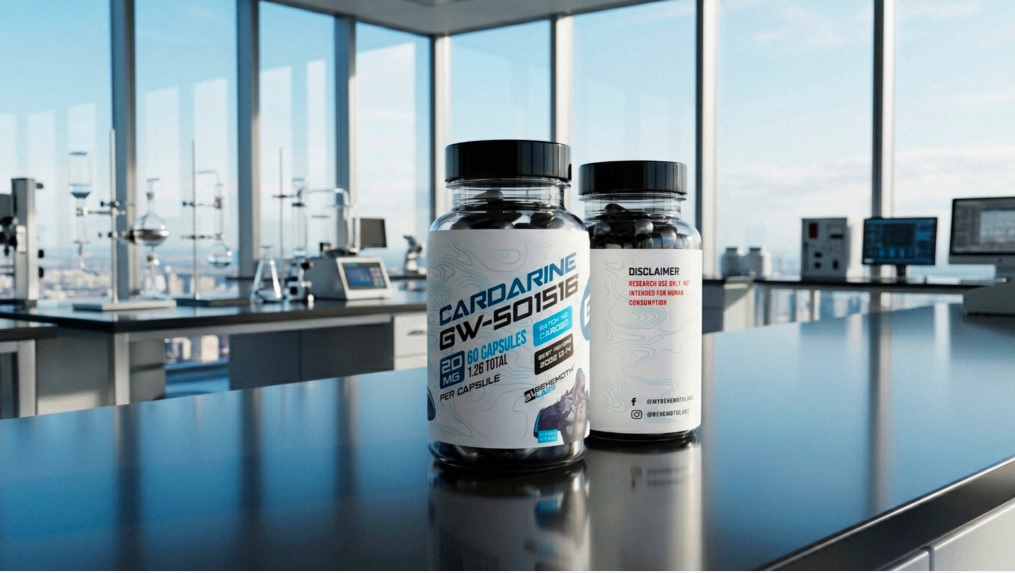
Cardarine GW-501516 is a synthetic chemical research compound. Cardarine for sale was originally developed in the 1990s as a potential treatment for metabolic and cardiovascular diseases. It is a PPARδ agonist studied in preclinical models for its apparent ability to shift mitochondrial substrate preference from glucose toward fatty acid oxidation in skeletal muscle tissue. All observations remain confined to experimental settings. It is not approved for human or veterinary use. Long-term safety data are absent, and carcinogenicity signals observed in animal studies represent a significant research limitation.
Introduction
Not many research compounds carry two opposing narratives simultaneously. Cardarine, formally GW-501516, is one of them.
On one side, there is a mechanism that has attracted genuine preclinical research interest. This is because the compound may interact with a receptor involved in how cells decide which fuel to burn. On the other side, there is a carcinogenicity signal that emerged in long-term animal studies. This caused GlaxoSmithKline to shut down all development in 2007.
Neither story exists without the other. If you are researching this compound, you need both.
This post examines how GW-501516 functions in metabolic substrate research, what the preclinical data actually show, and what the risk considerations are for laboratory use.
Disclaimer: Cardarine (GW-501516) is a research compound not approved by the U.S. Food and Drug Administration (FDA) for human or veterinary use. It is not intended to diagnose, treat, cure, or prevent any disease. This product is strictly for laboratory research purposes only.
What Is Cardarine (GW-501516) as a Research Compound?
GW-501516 is also known as Cardarine. It is a synthetic compound that acts on a receptor called PPARδ. It was developed originally as part of research into metabolic conditions.
GW-501516 is not a SARM. It gets mixed up with SARMs regularly online. However, that is scientifically wrong. SARMs interact with androgen receptors. GW-501516 does not. It works through a completely different pathway.
The FDA does not approve it. It is not approved for human or veterinary use anywhere in the world.
Chemical identity:
- IUPAC name: 2-[2-methyl-4-[[4-methyl-2-[4-(trifluoromethyl)phenyl]-1,3-thiazol-5-yl]methylsulfanyl]phenoxy]acetic acid
- Molecular formula: C₂₁H₁₈F₃NO₃S₂
- Molecular weight: 453.5 g/mol
- CAS number: 317318-70-0
- Classification: PPARδ agonist (non-SARM)
GW-501516’s selectivity for PPARδ over other PPAR subtypes has been reported in the literature at greater than 1,000-fold. This is what makes it a useful tool for isolating PPARδ-specific downstream effects in experimental metabolic models.
Why Is PPARδ Central to Metabolic Substrate Research?
PPARδ is a protein found inside cells. This is specifically true in the cell nucleus. Think of it as a switch. When something binds to it, it turns certain genes on or off. In this case, the genes it may affect are ones involved in how the cell handles fat and energy.
PPARδ is concentrated in skeletal muscle specifically. Its levels are approximately 10 times higher than PPARα and 50 times higher than PPARγ. That is one reason it has been studied in the context of muscle metabolism and fat processing (both in preclinical laboratory settings).
The selective activation of this receptor is the reason why it has been used in laboratory settings to investigate what happens when PPARδ is switched on.
When activated, PPARδ initiates the transcription of genes involved in:
- Fatty acid transport (including FABP3)
- Beta-oxidation of fatty acids (including CPT1b and PDK4)
- Mitochondrial respiration and biogenesis
- AMPK-linked signalling pathways
How Does Cardarine (GW-501516) Function in Metabolic Substrate Lab Research?
All of the following findings are from in vitro or animal model studies only. None of this represents established human pharmacology.
How Cells May Process Fat Differently
One area researchers have investigated is whether GW-501516 changes how skeletal muscle cells handle fat versus glucose as an energy source.
In cell culture models, GW-501516 has been observed to upregulate genes involved in transporting and breaking down fatty acids. These include FABP3, CPT1, and PDK4. Simply put, it means that the cells appeared to shift toward using fat rather than sugar for energy.
That said, findings are not consistent across all models. This tells researchers that the effects may depend heavily on which cell type is being studied and under what conditions.
AMPK — The Cell’s Energy Sensor
A second area of investigation involves AMPK. This is a protein sometimes described as the cell’s built-in energy gauge. When energy runs low, AMPK activates to restore balance.
In laboratory studies, GW-501516 was observed to activate AMPK and increase fat transport and processing. Researchers found that both PPARδ and AMPK appeared to be involved in producing these changes.
Gene Expression in Skeletal Muscle
Researchers have also investigated whether GW-501516 changes which genes are active in skeletal muscle cells. This is specifically the case in genes related to breaking down lipids and regulating cellular energy.
In cell-based studies, PPARδ activation by GW-501516 appeared to produce a different gene expression pattern compared to when other PPAR subtypes were activated.
How Mitochondria Choose Their Fuel
Mitochondria are the structures inside cells that produce energy. They can run on either fat or glucose. Researchers have used GW-501516 in preclinical models to investigate whether PPARδ activation affects which fuel source mitochondria prefer.
Studies in isolated rat skeletal muscle observed a dose-dependent increase in fat oxidation alongside a reduction in glucose oxidation in that model system.
What Makes GW-501516 a Useful Tool in Metabolic Research Settings?
The research value of GW-501516 in preclinical metabolic substrate studies rests on three properties:
1. High receptor subtype selectivity: GW-501516’s reported >1,000-fold selectivity for PPARδ over PPARα and PPARγ allows researchers to isolate PPARδ-specific metabolic effects without the confounding contributions of other PPAR subtypes.
2. Defined downstream gene targets: The compound has a well-characterised downstream gene regulatory programme (CPT1, PDK4, FABP3, PGC-1α interaction) that provides measurable experimental endpoints in both cell culture and animal model settings.
3. Mechanistic specificity: As a nuclear receptor agonist acting through direct transcriptional regulation rather than a fast-acting receptor cascade, GW-501516 produces outcomes relevant to gene expression studies, metabolomics investigations, and substrate utilisation pathway analysis.
What to Look for in a Supplier when buying research-grade Cardarine for sale?
Check that every batch is independently third-party tested for purity and identity, and a Certificate of Analysis is available for each lot. You can try trusted sites like BehemothLabz, where all compounds are sold strictly for preclinical and in vitro research use.
Note: All BehemothLabz products are strictly for LABORATORY AND RESEARCH PURPOSES ONLY. They are not to be used for any human or veterinary purposes.
Disclosure: Sponsored by BehemothLabz. This content is for informational purposes only and does not constitute an endorsement of any product for human use.
What Are the Risks and Limitations of Cardarine (GW-501516) Research?
This section is mandatory reading before working with Cardarine (GW-501516) in any laboratory setting.
Handling Precautions:
GW-501516 should be handled by trained laboratory personnel only, in a controlled research environment. Use appropriate PPE at all times. Avoid direct skin contact or inhalation of any powder or reconstituted solution.
Exposure Risks:
GW-501516 is a synthetic PPARδ agonist research compound. No human safety data exists beyond very limited early-phase studies conducted before pharmaceutical termination. The World Anti-Doping Agency (WADA) has issued formal health risk warnings and added GW-501516 to its prohibited list. The Australian Therapeutic Goods Administration has classified it as a poisonous substance under Schedule 10. The FDA has issued warning letters to companies marketing GW-501516 products.
Storage: Store GW-501516 at −20°C in a dry, dark environment. Protect from light, heat, and moisture at all times. Keep sealed until use.
Conclusion
GW-501516 sits at an uncomfortable intersection of scientific interest and unresolved risk. Preclinical studies have investigated its potential to influence fat oxidation pathways, AMPK signaling, gene expression in skeletal muscle, and mitochondrial fuel selection (all in controlled laboratory settings). PPARδ remains an active subject of metabolic research, and GW-501516 has been used in in vitro and short-duration animal studies to probe how this receptor may work.
But its pharmaceutical development was terminated (not paused) because of what long-term animal data showed. That decision has never been reversed. No regulatory body has approved it. No clinical programme is pursuing it. Data remains limited. Risk profile is unresolved.
Frequently Asked Questions
What is GW-501516 investigated for in preclinical research?
GW-501516 has been used in animal and cell-based studies to investigate PPARδ-mediated pathways, specifically fatty acid oxidation, AMPK signaling, mitochondrial fuel selection, and lipid catabolism gene expression in skeletal muscle model systems. It is not approved for human use and is available strictly for laboratory research.
Is GW-501516 a SARM?
No. It is not a selective androgen receptor modulator. SARMs interact with androgen receptors. GW-501516 activates PPARδ, which is a completely different receptor that regulates gene expression related to fat and energy metabolism.
Is it safe to work with GW-501516 in a laboratory?
It carries a significant risk profile. Long-term animal studies produced carcinogenicity signals at multiple organ sites, which ended its pharmaceutical development. It is classified as a poisonous substance in Australia, and WADA has issued formal health risk warnings.
Is GW-501516 approved for human use anywhere?
No. It is not approved for human or veterinary use by any regulatory authority anywhere in the world. The FDA has issued warning letters to companies marketing it as a supplement or for human use. It is available strictly as a research compound for qualified laboratory use only.
What is the Cardarine format used in research?
Research-grade Cardarine (GW-501516) is available in capsule and powder formats for laboratory use. Each batch should be accompanied by a Certificate of Analysis confirming purity and compound identity. It is supplied strictly for in vitro and preclinical research applications and is not for human or veterinary use under any circumstances.
References
- Brunmair B, Staniek K, Dörig J, Szöcs Z, Stadlbauer K, Marian V, Gras F, Anderwald C, Nohl H, Waldhäusl W, Fürnsinn C. Activation of PPAR-delta in isolated rat skeletal muscle switches fuel preference from glucose to fatty acids. Diabetologia. 2006;49(11):2713–22. Available at: https://pubmed.ncbi.nlm.nih.gov/16960684/
- Tanaka T, Yamamoto J, Iwasaki S, Asaba H, Hamura H, Ikeda Y, Watanabe M, Magoori K, Ioka RX, Tachibana K, Watanabe Y, Uchiyama Y, Sumi K, Iguchi H, Ito S, Doi T, Hamakubo T, Naito M, Auwerx J, Yanagisawa M, Kodama T, Sakai J. Activation of peroxisome proliferator-activated receptor delta induces fatty acid beta-oxidation in skeletal muscle and attenuates metabolic syndrome. Proceedings of the National Academy of Sciences USA. 2003 Dec 23;100(26):15924–9. Available at: https://pubmed.ncbi.nlm.nih.gov/14676330/
ATTENTION: All BehemothLabz products are strictly for LABORATORY AND RESEARCH PURPOSES ONLY. They are not to be used for any human or veterinary purposes.